Lipid nanoparticle (LNP) engineering
Solutions for assembly, stability, tropism, functionalization & more
Context
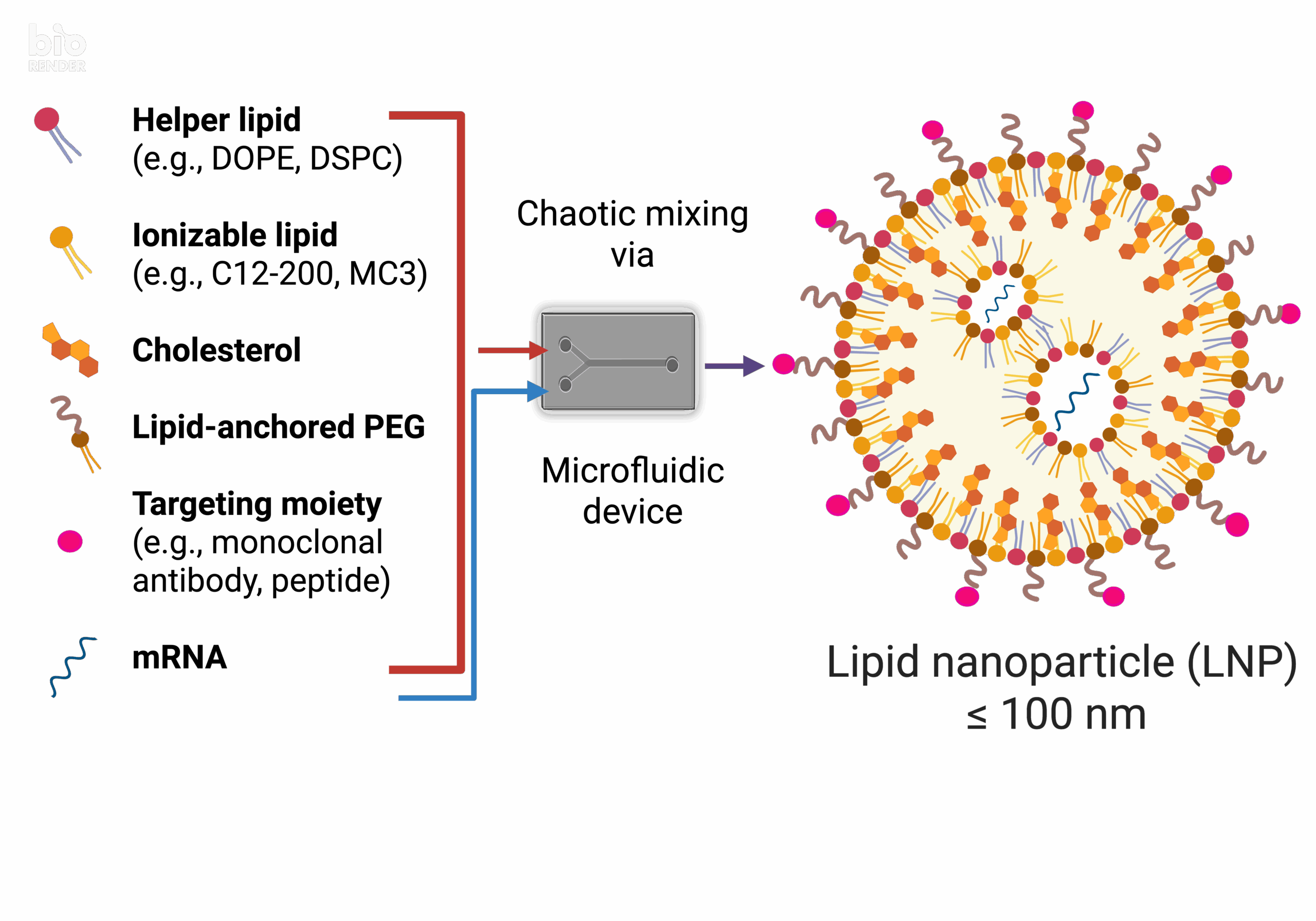
Lipid Nanoparticles (LNPs) for RNA delivery
Lipid nanoparticles (LNPs) have emerged as a powerful delivery platform for RNA therapies. Their effectiveness hinges on precise design and formulation, which dictate critical biophysical properties such as stability, biodistribution, and cellular uptake. However, optimizing LNPs for therapeutic success requires addressing key challenges such as:
Engineering ionizable lipids for stability and efficient delivery.
Enhancing tissue-targeted specificity while minimizing off-target effects.
Mitigating immunogenicity to reduce inflammatory responses and anti-PEG immunity.
Key Solutions for LNP Engineering
At Aganitha, our LNP engineering solutions integrate high-throughput machine learning and molecular dynamics to accelerate the discovery of ionizable lipids, ensuring maximum LNP payload delivery and stability. We leverage molecular modeling to optimize internal architecture and critical quality attributes, providing deep molecular insights for targeted RNA delivery.
Solution area
Ionizable Lipid Design
Our platform leverages high-throughput machine learning and molecular dynamics to accelerate the discovery of ionizable lipids, ensuring maximum LNP payload delivery, enhanced stability, and minimal toxicity.
ML-driven ranking of ionizable lipids for tissue-specific transfection efficiency with custom dataset integration.
- Predict LNP endosomal escape by calculating physics-based free energy of stalk formation for fusogenicity.
Solution area
RNA encapsulation and structural characterization
At Aganitha, we utilize high-resolution molecular dynamics and thermodynamic modeling to optimize LNP internal architecture, ensuring strategically stabilized RNA delivery and protection.
- Map ionizable lipid headgroup and mRNA backbone interactions using hydrogen bonds and binding free energies.
- Evaluate interaction propensities and spatial densities of LNP lipid constituents to optimize payload encapsulation efficiency.
Solution area
LNP structure and internal morphology
We employ atomistic and coarse-grained Molecular Dynamics to reveal LNP internal architecture, providing deep molecular insights into nanoparticle stability and dynamic evolution for optimized delivery.
- Characterize LNP structural reorganization during environmental transitions from formulation pH 4.0 to physiological pH 7.4.
- Map LNP architectural arrangement using radial, spatial, and number density distributions of lipids and water.
Solution area
LNP size and polydispersity
Our machine learning framework predicts LNP critical quality attributes, optimizing formulation and process parameters to achieve target particle size, uniform polydispersity, and maximum therapeutic bioavailability.
- Predict LNP mean particle diameter and Polydispersity Index using ML-based microfluidic flow rate modeling.
Solution area
Surface functionalization with mAbs/peptides
At Aganitha, we apply molecular dynamics and ML to engineer targeted LNPs, optimizing surface conjugation of mAbs and peptides for precise cell/tissue-specific delivery, ligand accessibility, and bioactivity.
- Optimize ligand accessibility and binding affinity through physics-based linker design to prevent steric hindrance.
- Assess functionalized LNP stability using MD simulations to derive molecular descriptors for ML-based prediction.
Select solution demo
Screening ionizable lipid libraries for tropism
AI-powered screening
AI models to predict and rank formulations on transfection efficiency for a target tissue/cell type.
MD simulation of LNP fusion
Multi-microsecond simulation of LNP-endosomal membrane fusion, with enhanced molecular dynamics (MD).