Architecting Continuous Scientific Discovery: The DISTILL Platform for Integrated Multi-Omics Research

In the first part of this series, we examined why modern biological research cannot rely on one-pass analysis. Single-cell, spatial, and multi-omics investigations demand repeated cycles of exploration, validation, and refinement to arrive at defensible scientific conclusions.
However, recognizing the need for iteration is only the beginning.
Supporting iterative science at scale requires more than analytical pipelines. It requires integrated platforms that align computation, biological interpretation, and collaborative decision-making within a persistent scientific environment.
DISTILLTM was designed around this principle. Rather than functioning as a set of disconnected tools, it provides a unified multi-omics workspace where data, context, and reasoning evolve together.
In this article, we explore how DISTILLTM translates iterative scientific workflows into structured, scalable, and reproducible discovery.
When Platforms Support Iteration, Insight Accelerates
As biological datasets grow in size and complexity, research teams are moving away from linear, pipeline-driven analysis toward integrated, iterative workflows. Rather than treating analysis as a one-time process, DISTILLTM is designed to support continuous cross-model reasoning, comparison, and refinement.
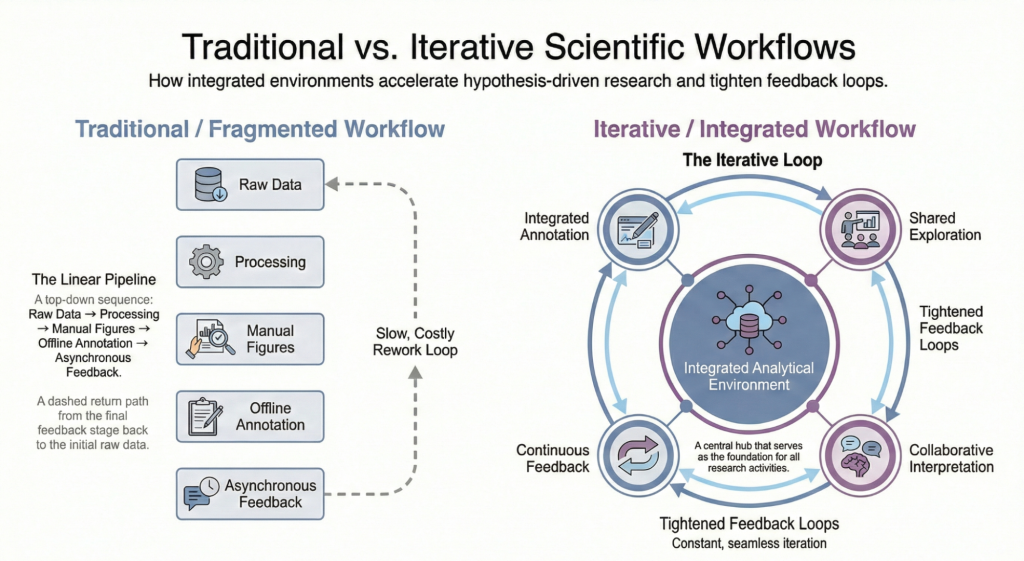
DISTILLTM operationalizes this shift through an integrated analytical architecture where computational analysis, visualization, and biological interpretation remain tightly connected. Instead of restarting workflows or transferring results across disconnected tools, researchers can iterate directly within the same analytical context that preserves continuity across decisions.
What Changes in the Workflow
With platforms like DISTILLTM, key aspects of daily analysis change:
- Continuous re-analysis without rebuilding pipelines
- Direct comparison across datasets and modalities
- Interactive visualizations that remain linked to underlying data
- Embedded reasoning tools for documenting analytical decisions
- Shared workspaces uniting domain scientists and computational teams
These capabilities reduce operational friction while strengthening reproducibility, transparency, and scalability across research programs.
What Changes in Scientific Behavior
As workflows become more fluid, scientific behavior evolves.
When iteration is lightweight, researchers explore alternative hypotheses more frequently. Interactive visual evidence encourages deeper investigation rather than early convergence on initial results. Integrated computational and biological reasoning enables teams to validate assumptions in real time.
As a result, scientific discussions become more evidence-driven, transparent, and collaborative. Hypotheses are refined continuously, and interpretation is guided by both quantitative outputs and biological context.
This shift is particularly visible in multi-indication studies, target prioritization programs, and exploratory spatial analyses, settings where no single analysis run is sufficient to support confident conclusions.
A Glimpse into Modern Multi-Omics Analysis
The impact of iterative, integrated workflows becomes most visible in real-world research scenarios, where multiple data modalities and analytical questions intersect.
Example 1: Integrating Single-Cell and Spatial Context
In single-cell studies, initial clustering often reveals broad cellular populations. However, deeper biological interpretation requires repeated refinement. Researchers may need to reassess clustering resolution, validate marker expression, and incorporate spatial localization to distinguish closely related cell states.
Within DISTILLTM, these refinements occur within a unified analytical context. Teams can adjust parameters, compare alternative annotations, and directly connect transcriptomic profiles to spatial tissue architecture. This continuity enables more precise identification of functional cell neighborhoods and context-dependent phenotypes.
Example 2: Cross-Modal Target Prioritization
In translational research programs, candidate targets are rarely evaluated using a single dataset. Instead, teams must integrate evidence from single-cell expression, pathway activity, bulk profiling, and clinical annotations.
DISTILLTM maintains this cross-modal evaluation within a connected analytical environment. Researchers can systematically compare signals, assess consistency across modalities, and document supporting rationale. Analytical steps remain traceable, enabling teams to understand how intermediate insights contribute to final prioritization decisions.
As a result, target evaluation becomes more transparent, reproducible, and biologically grounded.

DISTILLTM: A Platform Built for Continuous Scientific Reasoning
The workflows described above reflect a broader shift in how scientific discovery is conducted. As biological questions become more complex and interconnected, researchers require environments that support continuous reasoning, contextual interpretation, and collaborative validation.
DISTILLTM was designed around the principle that scientific insight emerges through sustained interaction between data, computation, and biological expertise. Rather than separating analysis from interpretation, the platform integrates data processing, visualization, annotation, and documentation within a persistent scientific environment.
This approach enables research teams to:
- Preserve analytical context across iterations
- Trace how hypotheses evolve over time
- Link quantitative results with biological rationale
- Maintain institutional knowledge across projects
By embedding reasoning and documentation directly into analytical workflows, DISTILLTM supports not only faster analysis but also more defensible and reproducible scientific conclusions.
Closing Thoughts
Single-cell, spatial, and multi-omics technologies continue to expand the scale and complexity of biological research. As datasets grow richer and scientific questions become more interconnected, the differentiator will not be computational speed alone.
It will be the ability to sustain contextual reasoning across analyses, teams, and programs.
DISTILLTM is built to embed that continuity directly into scientific workflows, transforming iteration from an individual effort into an institutional capability.
As biological research continues to evolve, platforms that embed iterative reasoning within their architecture will define the next generation of scientific innovation.