Iterative Insight in Single-Cell and Spatial Transcriptomics: Why First-Pass Analysis Falls Short
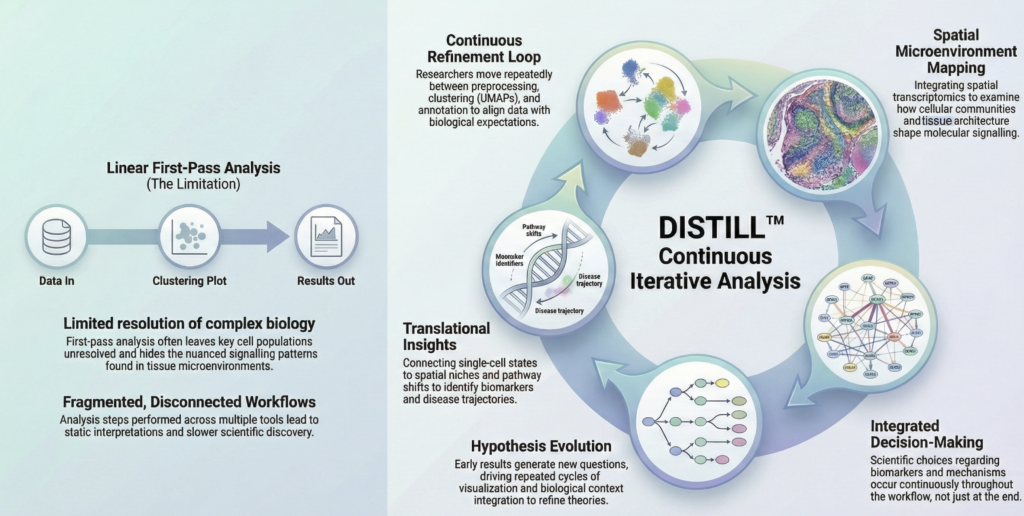
From Data to Decisions: Why Modern Biology Depends on Iteration
Single-cell, spatial, and multi-omics datasets rarely yield clear answers in a single pass. Scientists move repeatedly between analysis, annotation, and interpretation to arrive at defensible conclusions. In practice, insight emerges through iteration.
Modern biology now generates data at a level of granularity that was difficult to imagine a decade ago. Single-cell sequencing reveals transcriptional variation across thousands of individual cells. Spatial assays add positional context by mapping cells within tissues and microenvironments. Bulk and proteomic profiling contribute pathway-level and molecular signatures. Together, these modalities open new windows into disease biology and physiology.
What they do not provide on their own is a clean, linear path to answers. Translating rich data into biological decisions remains a scientist-driven process, one that rarely unfolds in a straight line. Platforms like DISTILLTM are designed around this reality. Rather than treating analysis as a one-time pipeline, DISTILLTM supports continuous exploration, comparison, and refinement, allowing scientists to connect computational results with biological context as their understanding evolves.
Insight emerges through iterative interpretation
A common assumption about computational workflows is that they resemble pipelines: data enters, results exit, and conclusions follow. In practice, scientific interpretation is iterative and context-dependent.
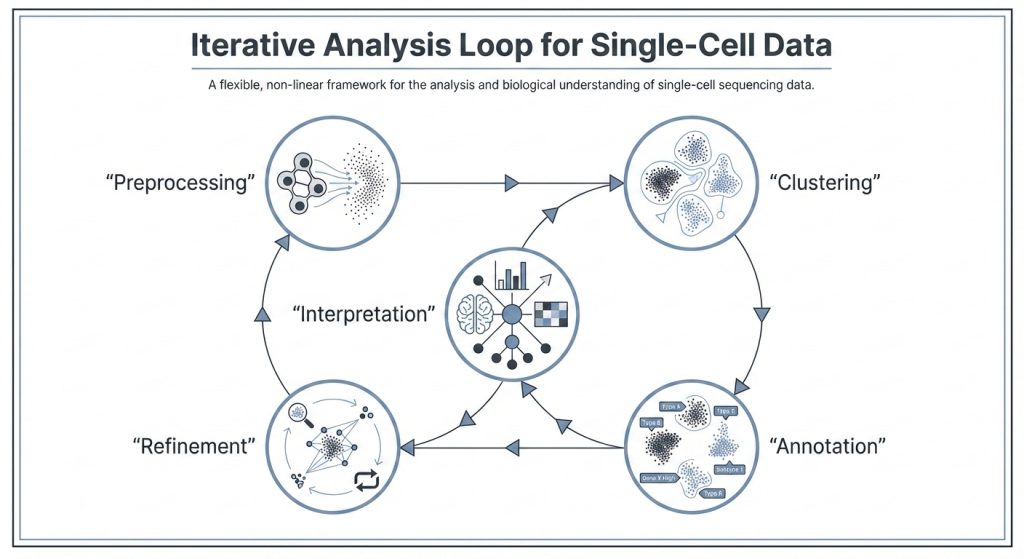
With single-cell datasets, researchers may begin with basic preprocessing and clustering, only to discover that key cell populations remain unresolved. They revisit normalization choices, adjust clustering parameters, test alternative marker sets, and repeat analyses until cell identities align with biological expectations.
Spatial datasets introduce additional layers of complexity. Researchers must examine how cell types are distributed within tissues, how neighborhoods co-localize, and how microenvironments shape signaling. These insights rarely surface in an initial analysis. They emerge through repeated movement between visualization, annotation, and biological context.
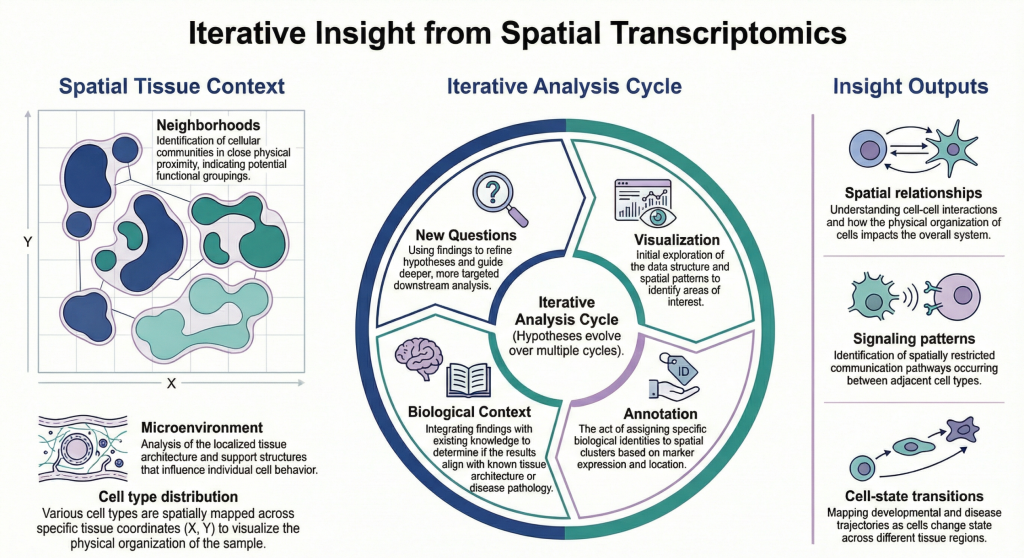
Across modalities, early results tend to generate new questions rather than conclusions. Meaningful insight depends on multiple analytical cycles in which hypotheses evolve and refine over time.
Fragmented tooling slows scientific decisions
Despite the iterative nature of scientific reasoning, many research teams still rely on fragmented analytical environments. Common challenges include:
- Analysis steps performed across multiple tools or notebooks
- Figures prepared manually for review and discussion
- Annotations updated offline and reapplied later
- Feedback exchanged through asynchronous documents and slide decks
As datasets grow larger and questions become more integrated, these gaps become increasingly visible. Linking single-cell states to spatial niches or pathway shifts to bulk signatures becomes difficult when workflows are disconnected.
The resulting bottleneck is not purely computational; it is scientific. When iteration is expensive, researchers explore fewer hypotheses. When communication is slow, biological and computational perspectives drift apart. When visualizations are static, interpretation stalls.
In this environment, the cost of iteration becomes the cost of discovery.
Scientific decisions happen throughout the workflow
In multi-omics research, important decisions are not reserved for the final stages of analysis. They occur continuously.
Scientists routinely evaluate whether clustering reflects biological structure, whether spatial neighborhoods align with known tissue architecture, whether pathway shifts replicate across models, and whether candidate targets withstand cross-modality scrutiny.
These judgments shape downstream strategy:
- Which biomarkers merit further investigation
- Which pathways represent plausible mechanisms
- Which cell states define disease axes
- Which indications warrant deeper evaluation
These are not passive observations. They are points of scientific choice.
Supporting such decisions requires more than generating results. It requires analytical environments that keep computational rigor and biological interpretation closely connected, enabling each to inform the other in real time.
Looking ahead
Modern biological research is defined by iteration. Insight emerges through repeated questioning, reinterpretation, and refinement. Yet many analytical environments remain optimized for linear workflows and static outputs. As datasets become richer and scientific questions more interconnected, this mismatch becomes increasingly limiting.
Platforms such as DISTILLTM are designed to address this gap by supporting continuous analysis, contextual interpretation, and collaborative reasoning within a unified environment.
To see it for yourself, watch a demo of DISTILLTM in action
In the next part of this series, we explore how modern analytical platforms, including DISTILLTM, are reshaping scientific workflows, making iteration faster, collaboration easier, and insight more accessible at scale.