De-Risking ASD Formulation Design: Connecting Thermodynamic Phase Behavior to Atomistic Molecular Mechanisms
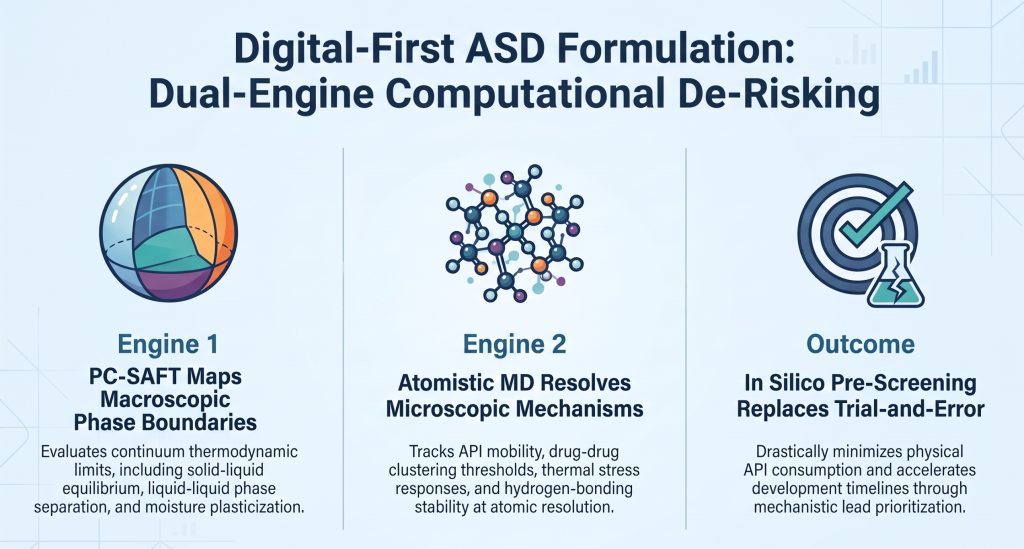
Coupling continuum thermodynamics (PC-SAFT) with atomistic molecular dynamics (MD) enables a digital-first approach to solid-state drug development by transitioning from empirical trial-and-error into rational physics-based risk identification.
1. Background: The Problem
The Solid-State Dilemma: Balancing Solubility & Physical Stability
A significant majority of small-molecule drug candidates in modern biopharma pipelines suffer from poor aqueous solubility (BCS Class II/IV). Amorphous Solid Dispersions (ASDs) have emerged as an established enabling strategy for transforming poorly soluble active pharmaceutical ingredients (APIs) into bioavailable oral drug products.
However, ASDs are non-equilibrium amorphous systems in which crystallization may be thermodynamically favored, depending on drug loading, drug-polymer miscibility, intermolecular interactions, and environmental factors (such as moisture & humidity, storage temperature, preparation and processing method, etc.).
Balancing Thermodynamics & Kinetics
ASDs require a balance between thermodynamic driving forces and kinetic barriers. Favorable drug-polymer interactions can reduce the driving force for crystallization, while high matrix viscosity, restricted molecular mobility, and slow structural relaxation can retard phase separation and crystallization over a target storage period and under defined storage conditions (e.g., 30°C / 65% RH). The same API-polymer interactions can influence both storage stability and dissolution, but the governing state variables and failure mechanisms are not identical.
Manufacturing Route & Processing Effects
The selected processing technology directly influences physical phase state, residual stress, and kinetic molecular mobility:
Spray Dried Dispersions (SDD): Rapid solvent evaporation kinetically traps the API in an amorphous matrix. However, residual processing solvent can act as a plasticizer, depressing glass transition temperature (Tg) and accelerating molecular mobility during storage.
Hot Melt Extrusion (HME): High thermal energy and mechanical shear drive API–polymer mixing. However, high melt viscosity and elevated processing temperatures increase kinetic degradation risks and require precise evaluation of high-temperature miscibility boundaries.
In silico modeling evaluates solvent plasticization effects for SDD and high-temperature melt miscibility and viscosity limits for HME before processing.
2. Approach: The Solution
At Aganitha, we leverage continuum-scale thermodynamic modelling to map the thermodynamic boundaries of ASD formulations and atomistic molecular dynamics to elucidate the molecular factors that govern these boundaries. Using both PC-SAFT (Perturbed-Chain Statistical Associating Fluid Theory) and Molecular Dynamics (MD), our framework provides complementary perspectives on formulation risks across composition and length scales.
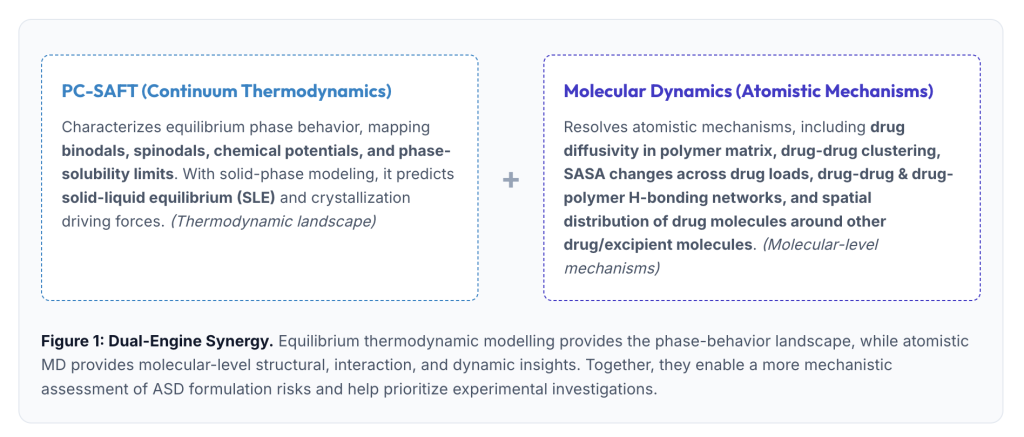
2.1 Macroscopic Thermodynamics: PC-SAFT State Boundaries
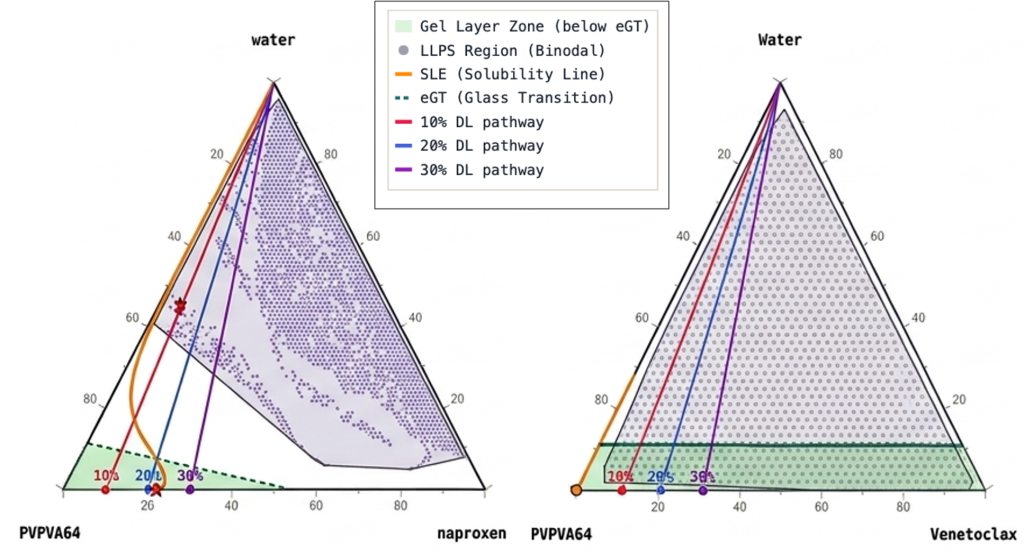
Powered by high-performance computational frameworks, Aganitha’s PC-SAFT modeling generates API / Polymer / Excipient (Water) ternary phase diagrams capturing key thermodynamic and formulation-relevant state boundaries:
- Escape Glass Transition (eGT): Explicitly models water plasticization during hydration: the composition at which absorbed water depresses the system’s Tg to the dissolution medium temperature, increasing molecular mobility and enabling the hydrated interfacial layer to transition toward dissolution/erosion.
- Solid-Liquid Equilibrium (SLE): Establishes the equilibrium solubility boundary of the crystalline API, identifying compositions where the crystalline phase is thermodynamically favored.
- Liquid-Liquid Phase Separation (LLPS): Identifies amorphous-amorphous demixing boundaries; depending on the resulting phase morphology and interfacial connectivity, LLPS can contribute to loss of release. For dissolution performance, the consequence of LLPS depends not only on whether phase separation occurs, but also on the composition, connectivity and morphology of the resulting drug-rich domains.
2.2 Microscopic Molecular Dynamics: Atomistic Mechanisms
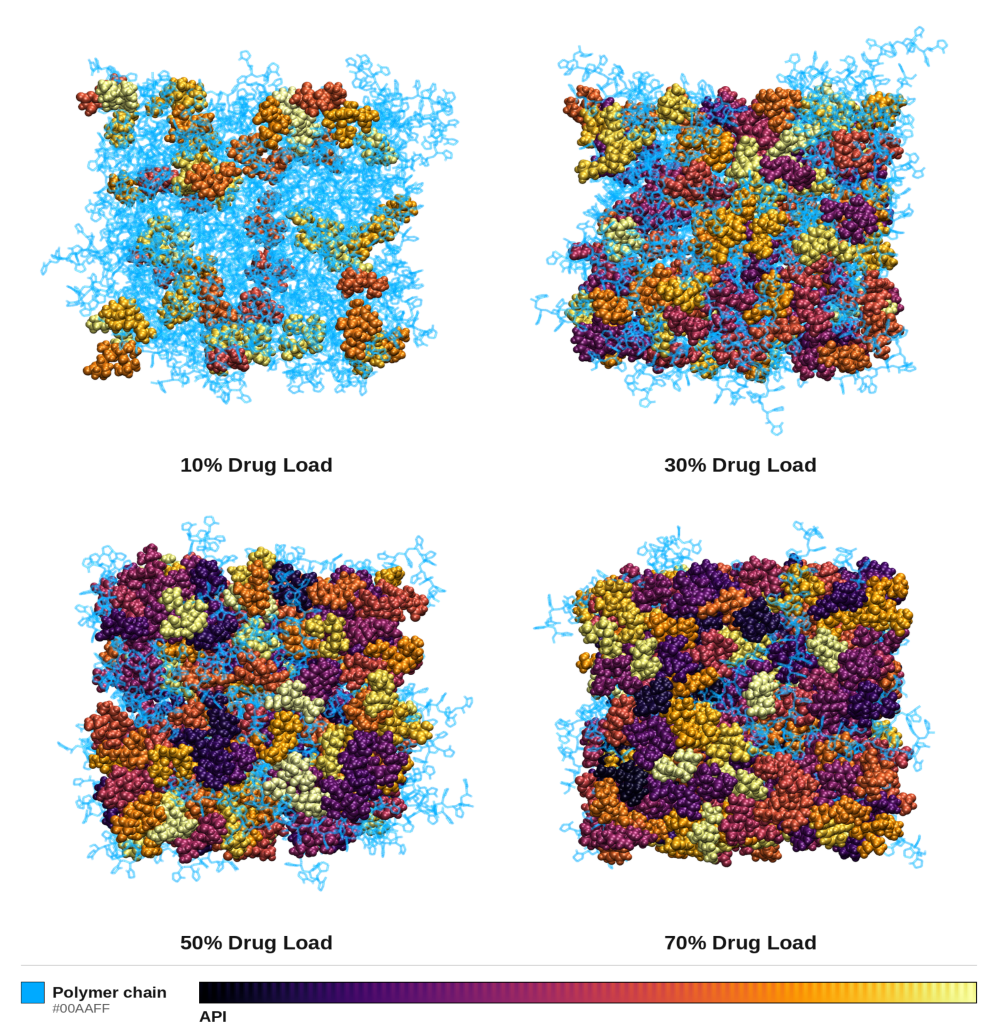
While continuum thermodynamics establishes where phase boundaries lie, Atomistic Molecular Dynamics (MD) reveals why formulations behave the way they do. By simulating API-polymer systems at atomistic resolution, our platform uncovers how drug loading, polymer matrices, and thermal stress impact molecular organization and long-term stability.
- Experimental thermal benchmarking: The computational protocols accurately capture experimentally observed thermal properties across tested API–polymer systems. For glass transition temperature (Tg), the Pearson correlation between experimentally determined values and values estimated using our MD protocol reached 0.93 for individual components across molecular weights, and 0.94 for binary API–polymer formulations across drug loads, while solid–liquid coexistence simulations reliably rank-order melting-point depression (ΔTm).
- Drug loading and molecular aggregation: Increasing drug concentration progressively changes intermolecular organization within an ASD. By tracking hydrogen-bonding networks and self-association across drug loadings, simulations reveal distinct API-specific aggregation thresholds. For example, Simvastatin showed an earlier onset of drug–drug clustering at lower drug concentrations, whereas Acetaminophen maintained dispersion until higher loadings, illustrating how MD resolves concentration-dependent stability limits.
- Molecular response under thermal stress: Simulations under elevated thermal stress conditions probe how formulation structure responds to processing heat representative of hot-melt extrusion. Thermal energy selectively disrupts drug–polymer hydrogen bonds, increasing drug mobility and allowing transient clusters to redistribute within the liquid phase while revealing API-specific retention of secondary interactions.
- Polymer-dependent drug mobility: Direct mobility comparisons across polymer matrices quantify API diffusion coefficients under thermal stress. Across tested APIs, PVP demonstrated lower drug diffusivity than PVPVA64, reflecting stronger mobility restriction within the PVP matrix under the evaluated conditions.
- Moisture and humidity effects: Introducing explicit water molecules into atomistic API–polymer systems across target Relative Humidity (RH) levels quantifies water-induced plasticization, disruption of protective interactions, and kinetic mobility acceleration under humid storage conditions.
- Intermolecular interaction profiling: Comprehensive energetic and structural profiling evaluates the thermodynamic strength, interaction energy distribution, and structural lifetime of API–API, API–polymer, and API–water hydrogen-bonding networks, distinguishing robust stabilizing interactions from labile associations.
Together, structural descriptors, spatial distribution metrics, and transport coefficients deliver an actionable, molecular-level map of formulation risk, giving CMC teams the mechanistic insight needed to design stable, high-performing ASDs.
Multi-Scale Architecture & Long-Term Aging
Standard nanosecond-to-microsecond atomistic MD cannot directly simulate multi-month physical aging or micro-scale phase separation dynamics. To bridge these spatial and temporal scales, our computational architecture integrates fine-grained atomistic molecular dynamics with coarse-grained and structural relaxation models. Multi-scale simulations extract essential transport parameters and kinetic descriptors, which parameterize higher-level mesoscale frameworks to reliably predict long-term physical aging and shelf-life.
3. Outcome: The Value Add
By connecting thermodynamic phase behavior to molecular mechanisms, biopharma CMC teams make rational, risk-aware formulation decisions early in development.

Ready to De-Risk Your Solid-State Formulations?
Connect thermodynamic phase behavior to molecular mechanisms to de-risk your ASD assets.
Contact Us