Aganitha’s EAGLE™ for Environment-Aware Cyclic Peptide Conformation
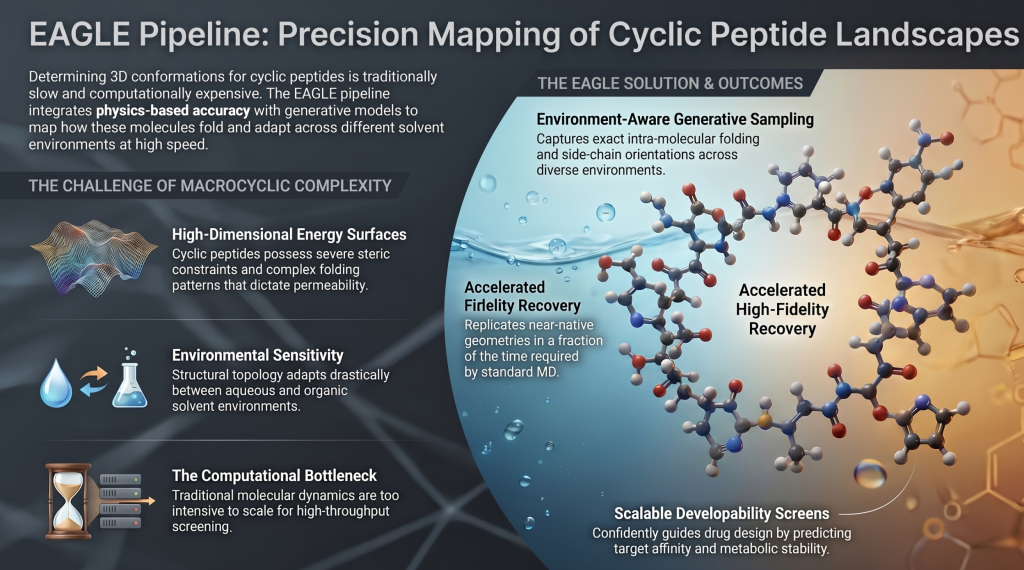
Capturing complex macrocyclic structures with extreme precision and speed across diverse environments
Cyclic peptides are rapidly emerging as a powerful therapeutic modality for targeting challenging protein interfaces that remain inaccessible to conventional small molecules and biologics. However, their success depends heavily on a precise understanding of conformational behavior, as these molecules exist as dynamic ensembles rather than a single static structure. Traditional experimental structural characterization techniques such as NMR and crystallography remain low throughput, costly, and unscalable for screening millions of candidates. Existing in silico conformer generation methods fall short: physics-based sampling is computationally expensive for large libraries, while cheminformatics and generative AI models frequently fail to capture the full low-energy conformational landscape. To address these limitations, Aganitha developed EAGLETM, a computational platform designed for rapid and accurate macrocyclic conformer generation. This case study evaluates EAGLETM’s capability to sample native-like structures across structurally diverse cyclic peptides spanning 2,000 to 3,400 Da. By balancing speed and predictive accuracy, EAGLETM delivers a scalable framework that significantly accelerates downstream structure-based peptide discovery workflows.
Overview
Determining accurate 3D conformations of cyclic peptides is critical, as their geometric folding directly dictates cell permeability, metabolic stability, and target binding affinity. This case study highlights Aganitha’s EAGLETM pipeline, an environment-aware workflow that maps complex macrocyclic landscapes across varying solvent conditions. By integrating physics-based accuracy with accelerated generative models, EAGLETM eliminates the heavy computational bottlenecks of traditional molecular dynamics. The resulting high-fidelity ensembles confidently guide downstream peptide-based drug design and developability screens.
Design Challenge
Cyclic Peptides impose severe steric constraints, resulting in complex, high-dimensional potential energy surfaces. Their structural topology adapts drastically to local solvent environments, directly governing cell permeability and target affinity. Traditional cheminformatics tools fail to capture these intricate, environment-dependent conformational transitions, while physics-based molecular dynamics (MD) simulations are too computationally intensive to scale for high-throughput macrocyclic screening.
Outcomes
The implementation of the EAGLE pipeline achieved:
- – High-Fidelity Structure Recovery: Successfully captured near-native, experimentally validated cyclic peptide geometries.
- – Significant Speedups: Replicated complex structural trends in a fraction of the time required by standard, long-timescale MD simulations.
- – Scalable Pipeline Architecture: Created an efficient, automated method to screening cyclic peptides with environment realism.
This case study demonstrates how the EAGLETM pipeline unlocks the therapeutic potential of flexible cyclic peptides, matching structural accuracy with high-throughput development speed.
More on Aganitha’s EAGLETM Pipeline: Click here.