EAGLE™: A Scalable, Environment-Aware Generation of conformer ensembLE for Drug Discovery and Development
Introducing EAGLETM
Conformer generation is a foundational step in modern computational chemistry and drug discovery workflows. Molecular conformation directly influences
- drug–target binding,
- drug–drug interaction (DDI) potential,
- physicochemical properties,
- ADME behavior, and
- stability in solid forms.
Reliable conformer sampling is therefore essential across hit identification, lead optimization, and pharmaceutical development.
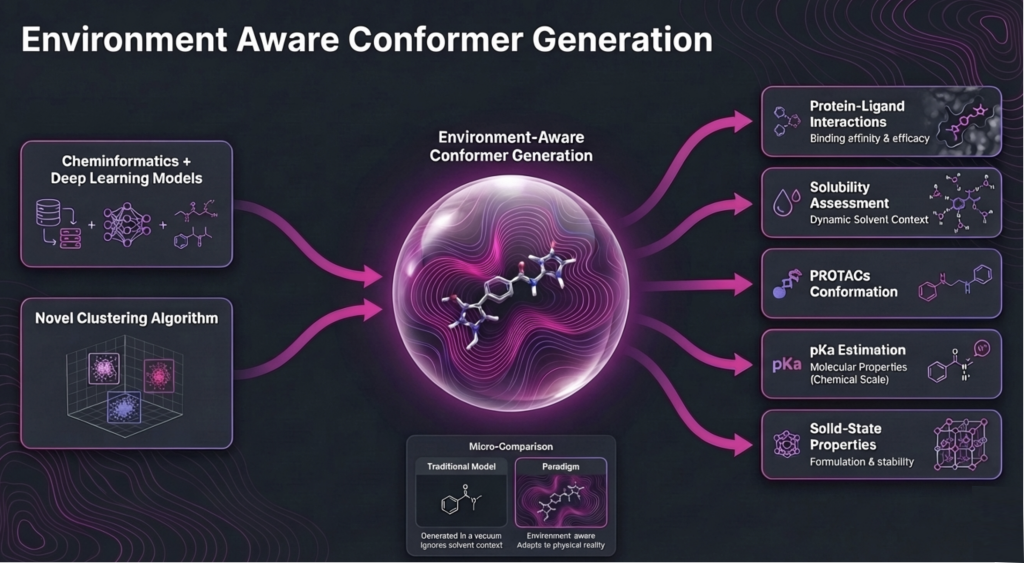
Aganitha’s EAGLETM pipeline is an environment-aware conformer generation pipeline designed to deliver accurate, scalable conformational sampling across biologically and pharmaceutically relevant conditions. By integrating established open-source computational engines within a unified algorithmic framework, EAGLETM enables robust conformer sampling beyond traditional vacuum-based approaches.
Why Conformer Generation is Critical across functions in Biopharma
Molecular conformation governs key determinants of drug performance, including binding affinity, pKa, solvation free energy, permeability, drug–drug interaction (DDI) risk, polymorphic stability, etc. Because molecular geometry adapts to its surroundings, conformers are inherently environment-dependent. A ligand’s conformation inside a protein binding pocket or in its solid form can differ significantly from that in vacuum or solution, directly influencing measurable properties that are key for drug discovery and development decisions.
Accurate conformer ensembles, therefore, enable reliable property estimation across environments.
- In solution, conformers influence pKa and solvation energies that guide crystallization and developability strategies.
- In protein pockets, the bound conformer determines hydrogen-bond networks and binding affinity for structure-based design.
- In the solid state, conformational preferences control crystal packing and inform CSP and polymorph screening.
- Conformers are also essential for AI-driven molecular modeling, where realistic 3D structures improve learning of structure–property relationships and prediction of biologically relevant behavior.
Limitations of Existing Conformer Generation Methods
Over the past three decades, several computational strategies have been developed for molecular conformer generation. These methods broadly fall into three categories: physics-based sampling, cheminformatics-based approaches, and generative AI–based models, each with distinct advantages and limitations.
- Physics-based methods, such as enhanced molecular dynamics and metadynamics, are considered the gold standard for conformational sampling because they rigorously explore the molecular potential energy surface. While highly accurate, these approaches are computationally intensive, making them difficult to scale for large compound libraries or high-throughput workflows.
- Cheminformatics-based methods rely on heuristic rules and rotatable-bond sampling to rapidly generate conformers. Although computationally efficient and widely used in screening workflows, these approaches often fail to capture the full low-energy conformational landscape, particularly for flexible or highly polar molecules.
- Generative AI-based approaches attempt to balance speed and accuracy by learning conformational patterns from molecular datasets. However, their performance is often constrained by training data bias and limited chemical diversity. In addition, most existing conformer generation methods—across all three categories—are primarily designed for vacuum or simplified environments, limiting their ability to capture environment-dependent conformational shifts relevant to protein binding, solvent effects, and solid-state structures.
Our Solution: The EAGLETM Pipeline
EAGLE addresses these limitations by enabling environment-aware conformational sampling within a scalable computational framework. The platform supports conformer generation across multiple solvent and biologically relevant environments, including aqueous, organic, cytoplasmic, membrane-like, and solid-state conditions.
By assembling open-source physics-based methods with Generative AI and a uniquely designed, highly efficient algorithm, EAGLETM delivers:
- Accurate conformer ensembles across environments
- Scalable workflows suitable for large compound libraries
- Improved prediction of protein-bound ligand conformations
- Solid-state conformer sampling for polymorph screening
- Reliable developability property estimation, including pKa in organic solvents
- Differentiation of flexible modalities such as PROTACs across environments
The result is a unified conformer generation framework that supports drug discovery, ADME/DMPK modeling, formulation development, and AI-enabled molecular design, without sacrificing scalability or environmental realism.
Benchmarking case studies
a) Case Study: PROTAC Conformations and Cell Permeability
Proteolysis-targeting chimeras (PROTACs) are large, flexible molecules whose three-dimensional conformations strongly influence cell permeability and pharmacokinetic behavior. Experimental studies comparing three structurally related PROTACs have shown that their permeability differences arise primarily from how the molecules fold in solution.
PROTACs that adopt extended conformations expose a larger polar surface area, reducing their ability to cross cellular membranes. A key descriptor used to quantify this behavior is the radius of gyration (Rg), which reflects molecular compactness. In contrast, compact or “spherical-shaped” conformations with lower Rg values shield polar groups through intramolecular interactions, improving membrane permeability. Traditionally, identifying such folded states requires long-timescale molecular dynamics (MD) simulations, which are computationally expensive and difficult to apply across large PROTAC libraries. The EAGLE conformer generation pipeline rapidly identifies relevant PROTAC conformations without the need for time-consuming MD simulations, capturing both extended and compact folded states required for permeability analysis and structure–property evaluation.
In a benchmark involving three related PROTAC molecules: P1, P2, and P3, experimental observations showed that the molecule among the above three PROTACs that adopts the most folded (spherical) shape (lowest Rg) exhibited the highest cell permeability. Aganitha’s EAGLE conformer generation successfully reproduced this folded state directly from conformer sampling, accurately capturing the experimentally observed structural trend without time-consuming MD simulations. This demonstrates the ability of EAGLE to rapidly identify permeability-relevant conformations for PROTAC design.
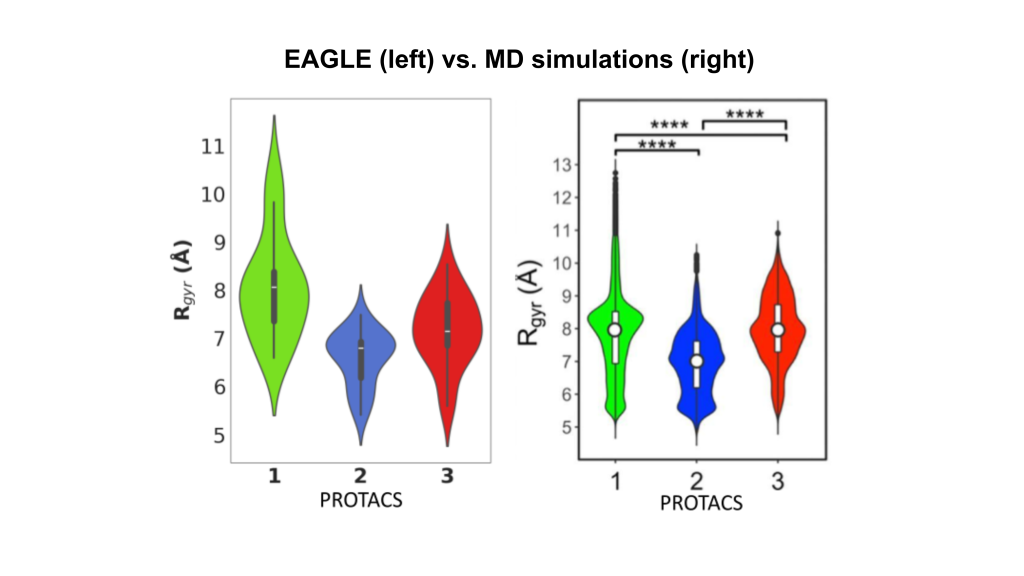
Figure 2: Conformer Generation in PROTACS: EAGLETM successfully captures trends observed in MD simulations
b) Molecules in Solid State
A benchmark suite of 525 small molecules was curated by aggregating the Milano, SUBBIG, Freedrug, and ORGMOL110 datasets. This integrated ensemble spans a broad spectrum of molecular sizes, degrees of freedom, and functional moieties essential for modeling solid-state conformational behavior. Consequently, these compounds provide a rigorous framework for evaluating the accuracy of environment-aware conformer generation within the EAGLETM pipeline.
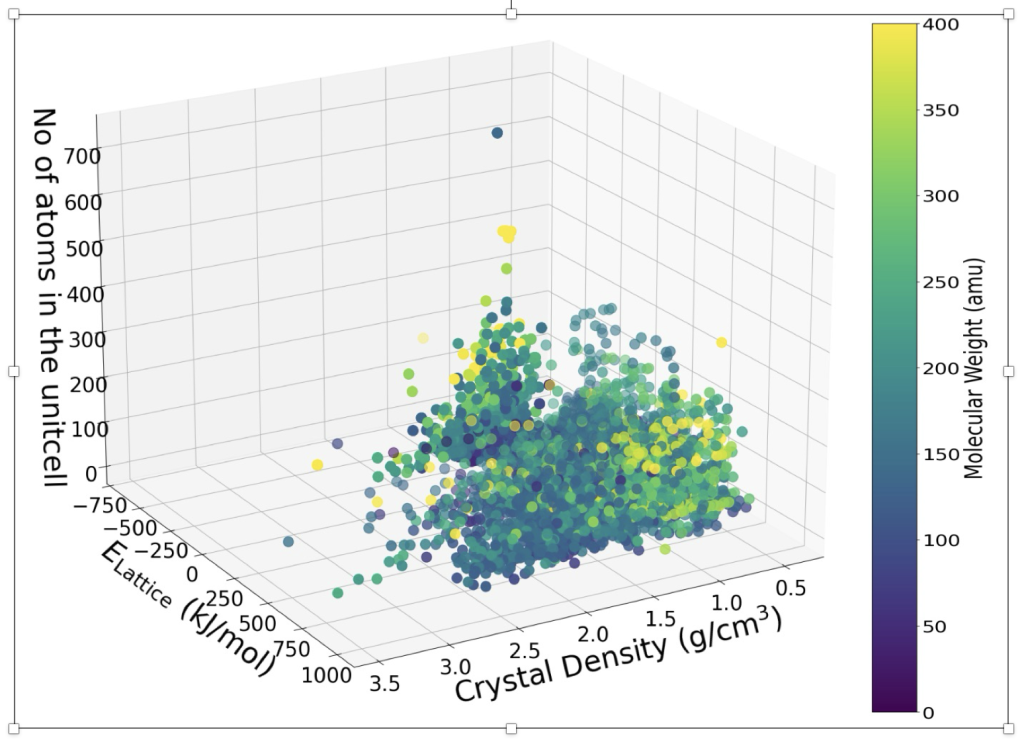

Figure 1 (a) Distribution of diverse density, atoms/unit cell, LE & MW of the crystal structures ; (b) Distribution of the space groups of the three benchmarking datasets
Performance Analysis and Computational Efficiency
EAGLETM demonstrates performance parity with, and in several instances superiority to, contemporary state-of-the-art conformer generation frameworks. Evaluated across a benchmark of 525 molecules, the model achieved an overall success rate of 92.4%.
A stratified analysis based on molecular weight (MW) highlights the model’s reliability across different chemical regimes:
- High-MW Regime (MW > 450 Da): Within this complex subset (n = 18), EAGLE successfully recovered near-native conformations (RMSD < 1 A0) for 66.7% of the candidates (12 out of 18). In comparison, CONF0RGE and Torsional Diffusion (TD) yielded success rates of 66.6% and 55.6%, respectively, underscoring EAGLE’s robustness in high-dimensional conformational spaces.
- Standard-MW Regime (MW < 450 Da): For smaller molecules, EAGLE maintained a high success rate of 93.3%, performing competitively alongside CONF0RGE (96.4%) and Torsional Diffusion (92.3%).
Furthermore, EAGLETM provides substantial gains in sampling efficiency. While conventional methodologies typically necessitate an initial pool of 3000 candidates to yield 50 final clustered conformers, EAGLE achieves comparable geometric coverage with a streamlined selection of only 20 final conformers derived from 1000 initial candidates. This marked reduction in ensemble size significantly diminishes the computational overhead for downstream crystal structure prediction (CSP) and solid-state screening workflows, enabling high-throughput applications without compromising structural fidelity.
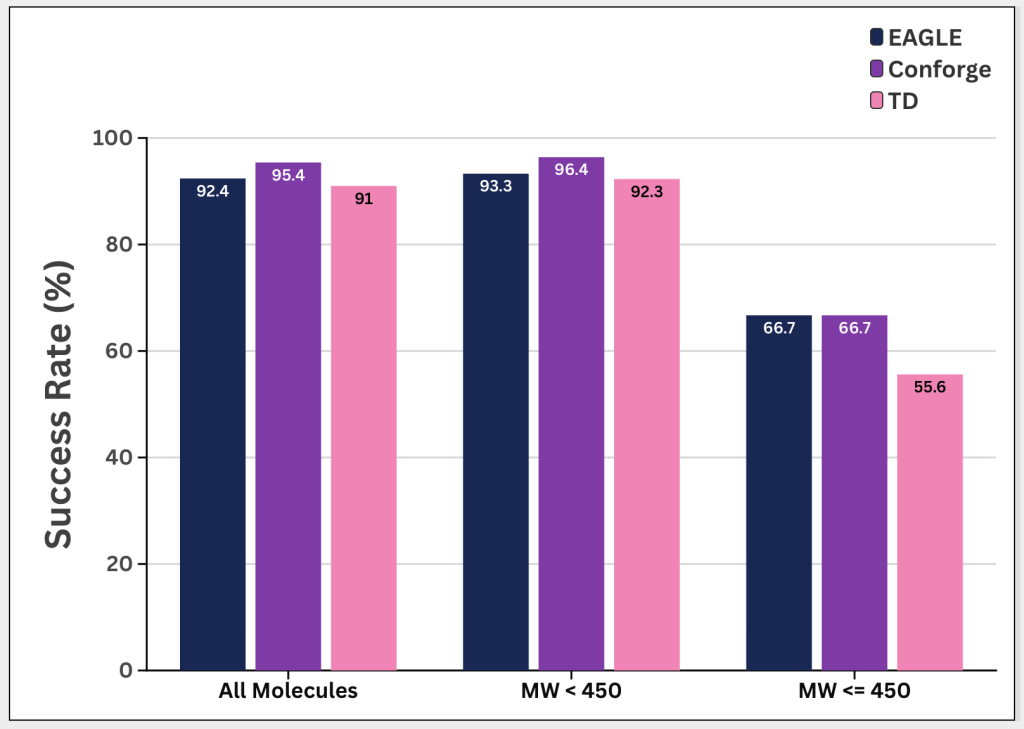
Figure 3: Comparison across conformer generation methods for small molecules
c) Ligands in Protein Pockets
To evaluate the ability of EAGLETM to reproduce experimentally observed ligand conformations, a benchmark dataset was constructed from the BioLIP database. A total of 1600 protein-ligand complexes were curated, restricting the dataset to cases, 446 in number, where the bound ligand is a drug-like molecule. The objective of this study is to assess whether conformers generated by EAGLE can reproduce the experimentally observed (ground-truth) ligand conformations in protein pockets.
For each of the 1600 ligands, 20 conformers were generated using EAGLETM. The generated conformers were then compared against the experimentally observed ligand structures, and the minimum RMSD between the ground-truth conformation and the generated conformer set was computed. A preliminary analysis was carried out using EAGLETM on a subset of 446 ligands. EAGLE successfully reproduced the experimentally observed conformations for 373 out of 446 ligands evaluated. This corresponds to an overall success rate of 83.63% on the analyzed subset. This performance underscores the capacity of the generated ensembles to reliably recover experimental geometries across a diverse range of drug-like ligands.
These results indicate that EAGLETM shows a significant improvement in reproducing experimentally observed ligand conformations, particularly for difficult cases where traditional approaches fail to generate near-native conformers.

Figure 4: Probability Distribution of the percentage of ligands that achieved at least one conformer within a given RMSD
Conclusion
The EAGLETM pipeline provides a scalable, environment-aware solution for conformer generation, effectively bridging the gap between computational speed and physical accuracy. By successfully capturing the exact conformers suitable for the experimental states observed in PROTAC permeability, solid-state packing, and protein-ligand binding, EAGLETM overcomes the limitations of traditional vacuum-based methods, which cannot estimate conformation in diverse environments. With a high success rate across diverse environments, EAGLETM serves as a robust foundation for modern drug discovery, from lead optimization to formulation development.