SitepKa: AI-Driven Site-Specific pKa Prediction Across Multiple Solvents
Predicting Molecular Behaviour Across Chemical Environments
Understanding how molecules gain or lose protons in different chemical environments is fundamental to designing better medicines, materials, formulations, and industrial processes. These protonation patterns influence molecular reactivity, solubility, drug absorption, formulation behaviour, reaction optimisation, and even electrolyte engineering.
In this work, we show how AI can predict not just whether a molecule will gain or lose protons, but also where within the molecule this happens and how that behaviour changes across different solvents — helping researchers evaluate molecules faster and earlier, reducing dependence on slow experimental testing alone.
AI-Driven Multi-Solvent pKa Prediction
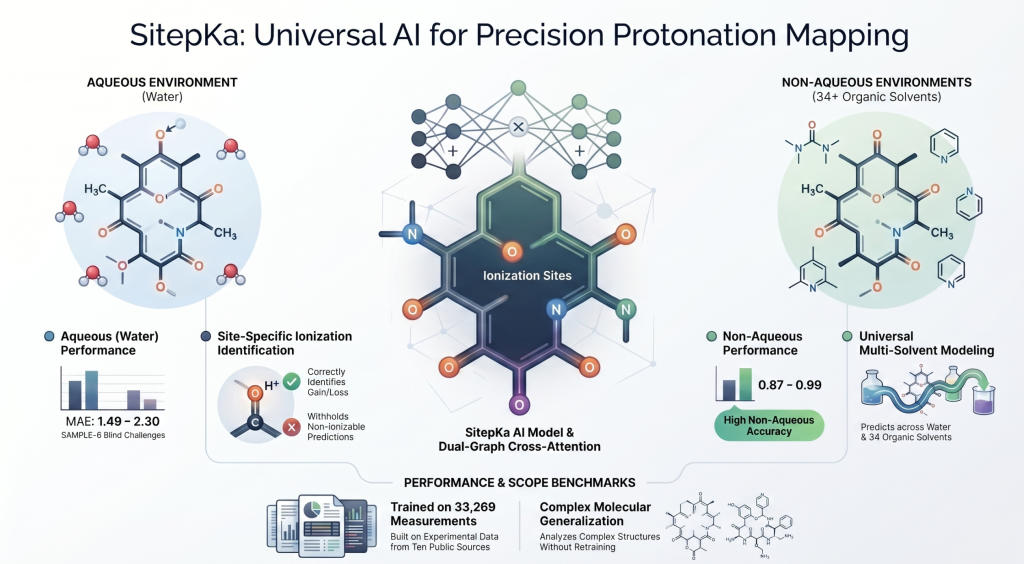
We introduce SitepKa, a graph neural network that predicts site-specific pKa values across water and 34 industrial organic solvents.
Rather than treating pKa as a single property of a molecule, SitepKa identifies which parts of a molecule can ionise and predicts how those sites behave across different solvents. The model combines explicit ionisation-site identification with a dual-graph cross-attention architecture that models solute–solvent interactions, supplemented by Kamlet–Taft solvent descriptors.
Highlights
- Trained on 33,269 experimental measurements from ten public sources
- Competitive accuracy on aqueous blind-challenge benchmarks (MAE 1.49–2.30 on SAMPL6–8)
- Effective transfer to non-aqueous solvents including DMF and pyridine (MAE 0.87–0.99), where deep-learning tools remain limited
- Generalises to structurally complex macrolides and glycopeptides well outside its training size range without retraining
- Correctly withholds prediction for non-ionisable atoms
This work is a step toward more chemically informed and solvent-aware AI systems for molecular R&D, particularly for amphoteric drug-like molecules, conformationally flexible chemotypes, and solvent-dependent medicinal chemistry workflows where protonation equilibria and site-specific ionisation behaviour cannot be adequately captured by a single macroscopic molecule-level pKa value.
Read the full preprint here.