Accelerating CNS drug discovery, design and delivery
CNS disorders demand more than target identification. Disease heterogeneity, complex neuronal biology and the blood–brain barrier create challenges across target discovery, therapeutic design and delivery.
We combine disease biology, multi-omics, AI and computational engineering to move CNS programmes forward on stronger evidence.
Our priorities in CNS
Delivery across the blood–brain barrier
Brain shuttles, AAV capsids, LNPs and oligonucleotide conjugates
Migraine
Causal targets and patient stratification
Parkinson's and Alzheimer's disease
Foundation models, and data from under-studied populations
WHAT WE DO
From target discovery to translational readouts
01
Target discovery
We characterise CNS disorders at the gene, transcript and tissue level to find disease mechanisms, therapeutic opportunities and biomarkers.
Deep genetic profiling & variant intelligence
From variant interpretation to functional consequence, splice-site and tissue-specific analysis.
AI-enabled target discovery for ASO
Prioritising disease-relevant genes, targets and biomarkers using genetics, multi-omics and biological evidence.
Multi-omics analysis
Genomics, transcriptomics, proteomics, single-cell and spatial data, integrated to understand CNS disease biology.
Literature & evidence intelligence
Published evidence, clinical studies, genetics and biological data, connected into structured target and disease intelligence.
02
Therapeutic design
Our computational workflows connect disease mechanisms with modality-specific therapeutic design.
Small-molecule design for the CNS
Brain exposure designed in alongside potency: permeability and efflux liabilities, CNS multiparameter optimisation, and receptor-subtype selectivity by molecular dynamics.
ASO & RNA therapeutic design
Transcript and isoform analysis, cryptic splice-site prediction with deep-learning models, target-site prioritisation and off-target assessment.
Gene therapy QC pipeline
Automated analysis of sequencing data for payload integrity, vector QC, structural events and genome-level characterisation.
03
CNS delivery
We combine computational screening, sequence analysis and structural biology to support development of CNS delivery systems.
Brain shuttles & oligonucleotide conjugates
Antibody and protein shuttles engineered to cross the blood–brain barrier through receptors such as TfR1 and CD98hc, and conjugates that carry RNA payloads into the brain.
AAV capsid engineering pipeline
End-to-end analysis of high-throughput capsid libraries: enrichment scoring, tropism assessment and candidate prioritisation for the CNS.
04
Translational readouts
We read brain activity and human cell models to characterise disease, stratify patients and measure what a therapy changes.
EEG biomarkers & endpoints
Brain-wave decomposition from delta to gamma, seizure detection, sleep staging and cognitive-state monitoring, as pharmacodynamic readouts and patient-stratification biomarkers.
iPSC & brain-organoid models
Imaging and omics models on human iPSC-derived organoids: disease progression, neurotoxicity and drug response.
CASE STUDIES
Selected CNS work
From partner programmes and our own research, with partner work anonymised.
Causal targets · Migraine · Our own analysis
Plasma proteins with causal evidence for migraine, by subtype
CGRP-pathway drugs help some patients and not others. We looked for causal targets beyond CGRP on public data, treating migraine with and without aura as separate diseases.
Public genetics and proteomics
Migraine-subtype GWAS and plasma pQTL data
Mendelian randomisation
Five MR estimators per protein, run separately for each subtype
Brain-tissue enrichment
Where in the brain these proteins are expressed
Answered: which plasma proteins have causal evidence for each subtype, and where in the brain they act.
7
plasma proteins with Mendelian-randomisation evidence for a causal role
2 · 5
with aura · without aura, each with its own profile
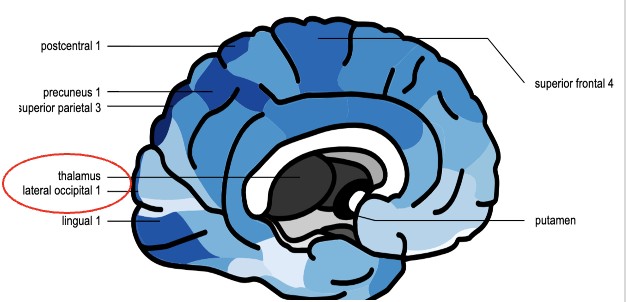
Brain-tissue enrichment for migraine with aura. The visual (lateral occipital) cortex and thalamus stand out, consistent with aura’s visual symptoms; migraine without aura has a different profile, in the cingulate, insula and entorhinal cortex.
Receptor selectivity · Multiple sclerosis · Published
Why siponimod activates S1PR1 but not S1PR2
Siponimod, approved for relapsing multiple sclerosis, acts on S1PR1 but not on the closely related S1PR2. Docking had put that down to a steric clash that stops it binding S1PR2.
Molecular dynamics
Siponimod and the natural ligand S1P, each simulated in both receptors
Binding
Siponimod binds S1PR2 with an affinity comparable to S1PR1
Activation
It fails to engage the transmission switches S1PR2 needs to signal; S1P engages them
Answered: where the selectivity actually comes from, and which residues to design against.
Selectivity comes from activation, not binding, the reverse of what docking had predicted.
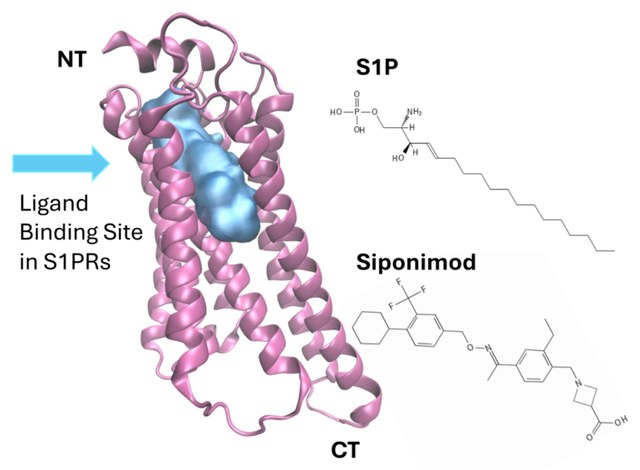
The ligand-binding site of the S1P receptors, with the natural ligand S1P and siponimod. From our blog on this work.
AAV capsid design · Blood–brain barrier · Published
Generative design beyond a directed-evolution screen
A screen covers a tiny fraction of possible capsid sequences. We trained a model on one and asked for variants it had never tested.
Learn from the screen
Enrichment in mouse brain endothelial cells, from a published in vivo screen, predicted from sequence alone
Optimise, then decode
Generative network and protein language models, decoded back to a short insert
Validate in simulation
Molecular dynamics against published penetrant and non-penetrant controls
Answered: whether a model trained on screen data can propose a variant better than the best the screen produced.
2x
stronger computed binding to LY6A, the mouse receptor that PHP.eB-type capsids use to cross the barrier, than the screen’s starting variant. A molecular dynamics result in a mouse model system, not a measured penetration assay or primate data.
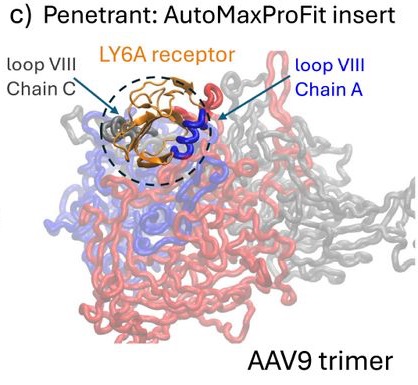
The designed capsid bound to its receptor, in simulation. Published as panel (c) of Figure 5 in the preprint, alongside the known penetrants and non-penetrants it was scored against. See all five panels
Deep target characterisation · Genetic epilepsy
From disease mechanism to therapeutic hypothesis
The causal gene was known; the way to drug it was not.
Disease biology
Literature, genetics and expression evidence, down to the cell types carrying the deficit
Pathway and mechanism of action
Where an intervention could act, and what it would have to achieve
Therapeutic hypothesis
Candidate mechanisms ranked, with the evidence each way
Answered: which mechanism a therapy should act on, and which modality can act on it.
Target & ASO strategy · Neurodevelopmental disorder
Direction of effect on a target with an approved inhibitor
The best-known drug for this target is an inhibitor, and the disease is loss of function — the wrong direction.
Variant landscape
Disease variants classified by consequence, complete loss separated from partial activity
Direction of effect
Disease direction read against the known pharmacology
Modality choice
Upregulation, correction and modulation weighed, each evidence gap named
Answered: whether to drug the target at all, and if so in which direction, before chemistry or ASO design begins.
Variant & transcript characterisation · Neurodevelopmental disorder
ASO target-site selection across the transcript
One working copy of the gene is lost. Raising output from the healthy copy means knowing the transcript, not just the gene.
Transcript and isoform map
The isoform that matters is not always the canonical one
Splice-impact assessment
Deep-learning splice models, per variant
Site selection and off-target screen
Sites ranked, then screened transcriptome-wide for sequences an oligo could bind by mistake
Answered: which sites on the transcript an RNA therapy can act on without binding elsewhere.
The platforms behind this work
Igniva™
Agentic AI platform combining domain-specialized agents, models, and workflows to accelerate scientific discovery
LOCUS™
AI-powered genomic analysis platform for translating genetic signals into causal disease insights, biomarkers, and therapeutic targets.
DBTIPS™
Platform for on-demand Dossiers on Disease/Target Biology & Related Market Intelligence
DISTILL™
AI-Powered Single-Cell Omics Platform for Multi-Omics Integration and Insights
Talk to a scientist about your CNS programme
Bring the target, modality or delivery question you are working on, and we will tell you which of our methods and data apply.