Rare-disease genetics and genetic medicines
We focus on rare genetic or auto-immune disorders and rare cancers.
From GWAS, *QTL, Multi-omics to RNA/Gene Therapy targets and designs, delivery systems (AAV/LNP/IL), safety assessments including Immunogenicity and Oncogenicity.
Biopharma R&D as well as N=1 precision medicine design and care.
Our contributions in rare disease therapies
AAV gene therapy
Capsid design, vector-genome integrity and integration safety
Enzyme-replacement therapies
Enzyme engineering and immunogenicity assessment
Variants of uncertain significance
Variant interpretation, and the genes and phenotypes behind a variant
WHAT WE DO
From disease studies to clinical testing
01
Disease studies & target identification
Which variant causes the disease, what it does to the protein or transcript, and which other phenotypes share its mechanism.
Variant interpretation
Effect prediction for coding and non-coding variants, using Ensembl VEP annotation, DNA, codon and protein language models, and the variant’s structural and regulatory context.
Rare-disease sequencing analysis
Workflows in NGS DataWorks™ that identify likely genetic causes of rare and hereditary conditions, prioritise variants by clinical relevance and add structural-variant analysis, on private cloud or HPC.
Related phenotypes & indication expansion
PheWAS and genetic correlation in LOCUS™ surface the phenotypes that share a disease’s mechanism; fine-mapping, colocalisation and Mendelian randomisation name the effector gene behind a locus.
02
Therapeutic & delivery-system design
Capsids, oligonucleotides and therapeutic enzymes, designed and screened computationally before synthesis.
AAV capsid & tropism design
Machine-learning models trained on published capsid data propose capsids with greater affinity for the target tissue, and simulation predicts tropism, as in our published design of capsids to cross the blood–brain barrier.
ASO design
Canonical and non-canonical splice-site prediction, target and ASO structure, complex stability, and a transcriptome-wide off-target screen.
Therapeutic enzyme engineering
Ancestral sequence reconstruction and protein language models propose variants of therapeutic enzymes, and deep-learning models predict their stability, solubility and activity before any variant goes to the wet lab.
03
CMC
Sequencing-based analysis of what vector synthesis produced.
Vector-genome integrity
Long-read sequencing of vector genomes to locate and count truncations and mismatches, the starting point for tracing them to a cause in synthesis.
04
Preclinical & clinical testing
Evidence on vector integration and immune response, for the safety questions that animal studies and trials raise.
Vector integration & genotoxicity
Host integration sites, what each one does to the genes around it, and genotoxicity assessment.
Immunogenicity assessment
In-silico assessment of the immune response to protein therapies and to viral vectors.
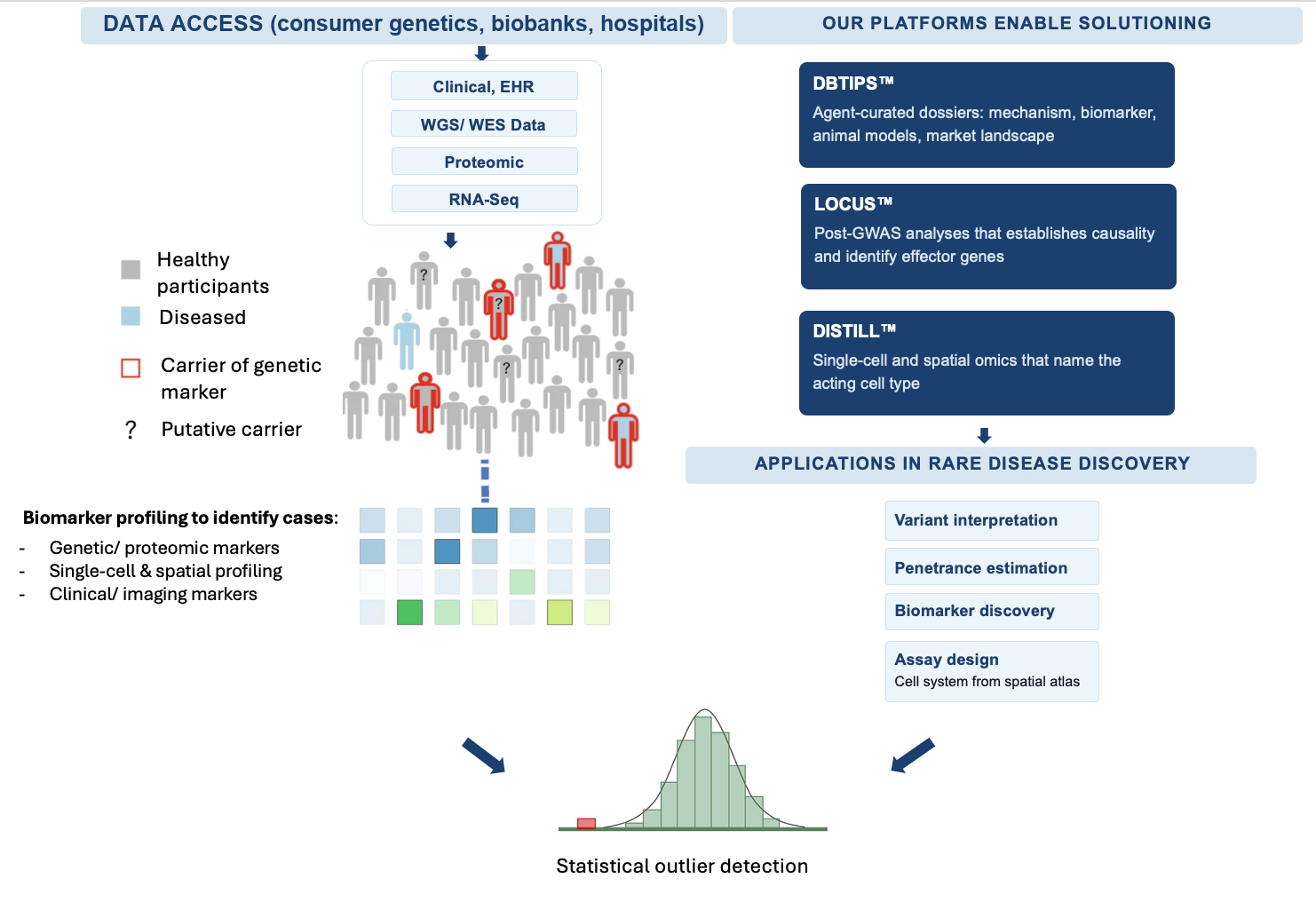
HOW WE FIND CASES
Finding undiagnosed carriers in population-scale cohorts
A rare variant is, by definition, an outlier. Identifying who carries one means profiling a whole cohort, then separating the few from the many.
CASE STUDIES
Selected rare-disease work
Vector safety · AAV gene therapy · Partner programme
Vector integration analysis behind a lifted FDA trial pause in a hematology related trial
Tumours had appeared in animal models and a clinical trial was paused. The question was whether the vector had caused them by fusing with the host genome.
Integration sites
Where the vector integrated in the host genome, from sequencing data
Neighbouring genes
What each integration could do to the genes around it
Genotoxicity
Whether host–vector fusion could account for the tumours
Answered: whether the tumours seen in animal models could have come from the vector.
Unlikely
that the tumours came from host–vector fusion
Lifted
the FDA clinical-trial pause, after a rapid resolution
<60 days
from the start of the analysis to resolution
Vector QC · Gene therapy
Truncated vector genomes in gene-therapy synthesis
A truncated vector can deliver an incomplete therapeutic gene. The task was to find where the truncations occur and what causes them.
Long-read sequencing
Oxford Nanopore reads that span whole vector genomes, which short reads miss
A dedicated pipeline
Read-length distribution, quality filtering and alignment, built on DNAnexus
Truncation and mismatch analysis
Each truncation event located and counted, with per-base variation
Answered: where the vector genomes were truncated, and how often, as the basis for finding the root cause.
Population genomics · Biobank-scale cohort · Partner programme
A GWAS pipeline scaled to biobank size
A genome-wide association pipeline taken from 50,000 exomes to 500,000 exomes and 200,000 genomes in a biobank-scale cohort.
60%
lower compute cost while scaling.
Immunogenicity · Enzyme replacement · Partner programme
Engineered variants of an approved enzyme-replacement therapy
More than 100 variants of an approved enzyme, engineered and compared on CD4+ T-cell immunogenicity.
Up to 20%
lower CD4+ immunogenicity across the engineered variants.
The platforms behind this work
LOCUS™
Genomic analysis platform for translating genetic signals into causal disease insights, biomarkers and therapeutic targets.
NGS DataWorks™
Sequencing data analytics for disease studies, functional genomics and oncology, on private cloud or HPC.
DBTIPS™
AI-enabled retrieval and harmonisation of disease and target evidence — literature, multi-omics, pathways, tractability, clinical and market context in one dossier.
DISTILL™
AI-powered single-cell and multi-omics platform for integrating transcriptomic and proteomic data across studies.
Igniva™
Agentic AI platform combining domain-specialised agents, models and workflows to run and reason over these analyses.
READ MORE
From our scientists
BLOG · GENE THERAPY
Personalised gene therapies are here & AI can help widen their availability
What a single-patient genetic medicine asks of vector engineering, payload design and safety evaluation.
PREPRINT · BIORXIV
Learning from and improving upon high-throughput screens for protein fitness with generative AI
Applied to AAV capsids designed to cross the blood–brain barrier.
Talk to a Scientist about your rare-disease programme
Bring the question you are working on, and we will tell you which of our methods and data apply, and what we have already done that is close to it.