Identifying Candidate Seizure Events in Long-Duration Mouse EEG Recordings

An EEG analysis workflow developed to help researchers identify, prioritize, and review candidate events in preclinical recordings.

A preclinical neuroscience team at a biopharma company was
studying spontaneous spike-wave discharges (SWDs) in a mouse
model, using EEG recorded continuously over several days. SWDs are
brief, rhythmic spike-and-wave patterns in the EEG. Aganitha
developed an analysis pipeline and review dashboard, now Intelligent
Seizure Detector, to help the team find candidate seizure events,
separate SWD-like activity, rank candidates against seizures the
researchers had already confirmed, and view each event alongside
the animal’s estimated brain state. In the pilot recording, the pipeline
output contained all three seizure events identified by the team’s
manual review.
The challenge of analysing long EEG recordings
Epilepsy studies in mouse models often rely on EEG recorded continuously for
several days. One animal can produce several 24-hour recordings, but the events
of interest may last only a second or two. Each event has to be found before it can
contribute to an event count, a frequency profile or a treatment comparison.
Manual review remains the reference standard. It is slow across many recordings,
and it is hard to apply the same judgement across animals and days. A fixed
amplitude threshold is faster, but signal amplitude varies between electrodes,
animals and sleep–wake states. The same threshold can miss events in one
recording and over-flag another.
The team wanted a faster way through long recordings that still showed the signal
behind each detected event and left the final decision with the researchers.
What the research team needed
- – Screen every hour of recording, err toward catching events (high recall),
with thresholds based on each animal’s own signal rather than a fixed value. - – Separate SWD-like events into a stricter group, while keeping the full candidate list available.
- – Rank candidates against confirmed events, without first building a large labelled training set.
- – Show each event in context, with the animal’s brain state at the time and a direct link to its EEG waveform.
How we analysed the recordings
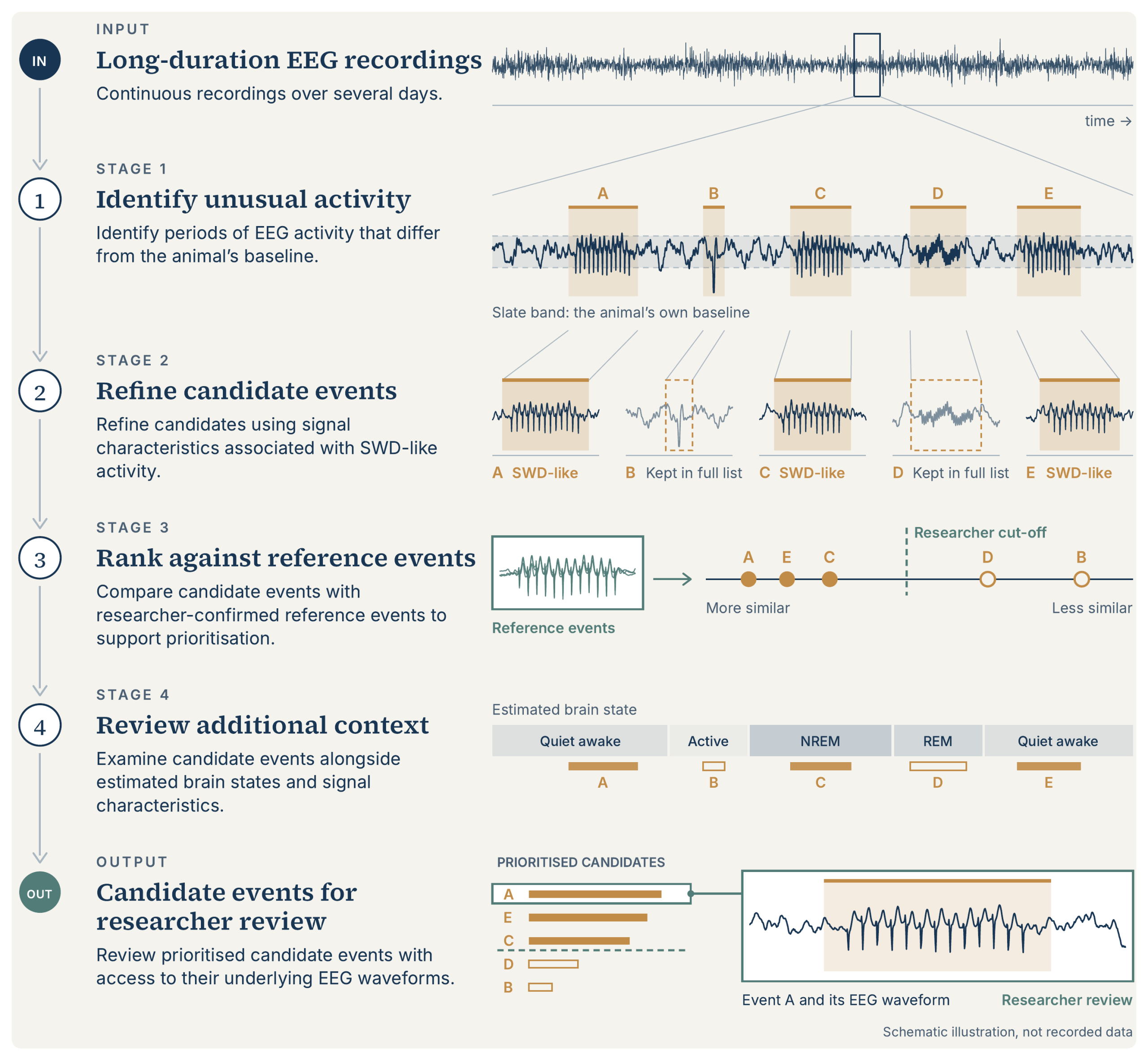
The workflow screens long-duration EEG recordings for candidate seizure events and organises them for review. Researchers can examine each candidate alongside its underlying EEG waveform and relevant signal context, including the animal’s estimated brain state, and make the final decision on every event. Brain-state labels are estimates and have not been compared with expert sleep scoring
What we found in the pilot study
The pipeline was tested on recordings from one animal of the disease model and one wild-type control.

The pipeline detected the three seizure events previously identified by the team, using the animal’s own signal as the baseline. These events were then used as references for ranking, so the ranking step was expected to keep them. Detection does not use them, so it is the independent part of this result.
The ranked output included 550 candidate events, 548 in the SWD-like group. Aside from the three confirmed events, the team had not reviewed any of the others, so they are candidates for further review, not confirmed seizures. The single wild-type event fits the expectation that healthy controls show no spontaneous epileptiform activity. The ranking was built from one recording, and only these two animals were processed, so it has not been tested on other animals. No precision,
recall, sensitivity or specificity figures are claimed for this pilot.
How this helps researchers review their data

Have a long-duration EEG study?
Talk to our team about using Intelligent Seizure Detector to identify, prioritise
and review candidate events in your preclinical EEG recordings.
Send us one recording, and we will go through its candidate events with your
scientists.
Reach us at: reach-us@aganitha.ai