Igniva™ for Chemistry
A modular suite of AI agents for computational chemistry tasks – from structural biology through molecule and material discovery to manufacturing and controls, built on physics based methods such as quantum mechanics and molecular dynamics as well as generative AI models.
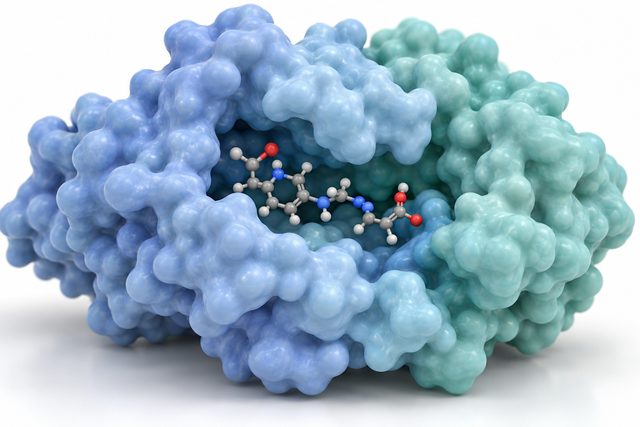
01
Drug discovery
- Target and pocket elucidation
Hit generation and screening
Hit-to-lead and lead optimization
02
Molecular profiling
Developability and degradability
pKₐ and solubility
Spectra prediction

R&D WORKFLOWS
Applications & Agents
01
Drug discovery
From a prepared structure and a pocket, through screening, to the poses and analogues that carry a lead forward.
Target and pocket elucidation
Simulation-ready structures and the conformer ensembles every later calculation starts from.
HAddiT
Hydrogen addition with bond orders and valency handled correctly, so a structure is simulation-ready before any calculation runs on it.
EAGLE™
Environment-aware conformer ensembles for the setting that matters — crystal packing, a given solvent or a protein pocket — including macrocycles and cyclic peptides.
MolConSUL
Conformer generation using unsupervised learning.
Hit generation and screening
Finding, filtering and generating the molecules worth a closer look.
ScreenXcel
GPU-accelerated virtual screening.
MolScreener
Medicinal-chemistry filtering of candidate molecules.
MolMatch
Analogue search across ultra-large molecular libraries.
MolGenAI
Generative de novo molecular design.
Hit-to-lead and lead optimization
The binding pose an affinity estimate depends on, and the analogues worth making next.
ChemTwin
Local chemical-space exploration around an input molecule.
PosePRO
Binding-pose prediction for flexible pockets: induced-fit docking with interfacial water and perturbation MD, for on-target, off-target and anti-target proteins.
02
Molecular profiling
The properties that decide whether a molecule can be developed, predicted per site, per solvent or per atom.
Developability and degradability
Whether a molecule gets where it must, and what it turns into on the way.
NitroSafeAI
Nitrosation risk screening for APIs and excipients, scoring each nitrogen atom in the structure and benchmarked on public data.
CycPepPer
Cyclic-peptide permeability classification with counterfactual design.
pKa and solubility
Which site ionises, and which solvent to use, per solvent rather than per molecule.
SitepKa
Site-specific pKa prediction in water and 34 organic solvents, giving the site that ionises rather than a single value for the molecule.
SolviScope
Solubility and solvent ranking for solvent and antisolvent selection, with the report stating where the method applies and where it does not.
03
Drug substance
The solid the API is made as: which packings are plausible, and what they weigh.
Solid-form and polymorph screening
Crystal structures cleaned up, ranked and measured before a form is chosen.
CrystalClean Pro
Automated crystal-structure cleanup and supercell generation.
LENet
Machine-learned lattice-energy ranking for crystal screening.
TruRho
True-density estimation for active pharmaceutical ingredients.
04
Drug product
The formulation around the API: where to start, and which excipients behave.
Excipient selection and compatibility
Formulation starting points for a new API, and how its excipients behave in solution.
API surrogate search
A searchable portal of approved APIs with their physicochemical data and the inactive ingredients of approved formulations, for formulation starting points.
MicelleAI
Critical micelle concentration for surfactants and mixtures.
FAQ
Deployment
Models
Data
Audit
Role-based access, with audit logs for every run and export
Agent packs by analysis type
Igniva™ runs agents from these packs contextually with a scientist signing off at key checkpoints.
MOLECULAR DYNAMICS
How does this molecular system behave over time?
CRYSTAL PREDICTION
Which crystal packings should we investigate?
SMALL MOLECULE DISCOVERY
Which molecules should move forward for investigation?
FORMULATION
Which drug–excipient combinations deserve closer study?
DATA CURATION
How can papers and patents become usable scientific data?
RESULTS
Select Case Studies
Small molecule · Physico-chemical properties
Site-specific pKa in water and 34 organic solvents
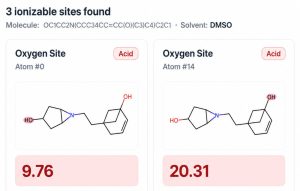
SitepKa output for one molecule in DMSO: A predicted pKa for each ionizable site. 2 of its 3 ionizable sites are shown.
Methods
Dual-graph neural network · solute–solvent cross-attention · Kamlet–Taft solvent descriptors · DFT
Challenge
Process chemists work in organic solvents, but most deep-learning pKa models predict only in water, or give one value per molecule instead of one per site. Physics-based methods handle other solvents but are slow for large molecules.
Approach
SitepKa predicts a pKa for every ionizable site. Trained on 33,269 experimental values from ~10 public sources mined using Aganitha’s data curation agents.
Evidence
Preprint: SitepKa, ChemRxiv, May 2026, presented at ACS Fall 2026. Mean absolute error is 1.49–2.30 on the SAMPL6–8 aqueous blind challenges. For large molecules in 9 non-aqueous solvents, a DFT protocol with Aganitha’s in-house solvent-specific conformer generation pipeline, achieved an MAE of 2.23 on 52 validation molecules, ~100× faster than gold-standard physics protocols.
Outcome: pKa for each ionizable site across solvents used widely in the industry, to guide salt, co-crystal and crystallization-solvent choices
Impurity control · Regulatory CMC · Toxicity
NitroSafeAI: Nitrosation risk screening for APIs and excipients

NitroSafeAI’s knowledge-based & Deep-learning based scoring of ranitidine: a score and likelihood for each nitrogen, with the possible nitrosated product identified.
Methods
Knowledge-based scoring with 3 activating and 12 deactivating features · Graph Attention Network
Challenge
Nitrosamine impurities led to recalls and withdrawals of drugs including valsartan, ranitidine and varenicline, and FDA guidance for manufacturers is to assess nitrosamine risk in their products.
Approach
NitroSafeAI scores each nitrogen atom two ways: rules that encode known nitrosation chemistry, and a graph network trained on measured nitrosation yields.
Evidence
84% accuracy on a public benchmark of 437 nitrogen atoms in 207 molecules (Reiss et al., Chem. Res. Toxicol. 2025).
Outcome: A ready-to-deploy in silico tool that flags which nitrogen atoms in an API or excipient can form a nitrosamine
Drug product · Excipient selection
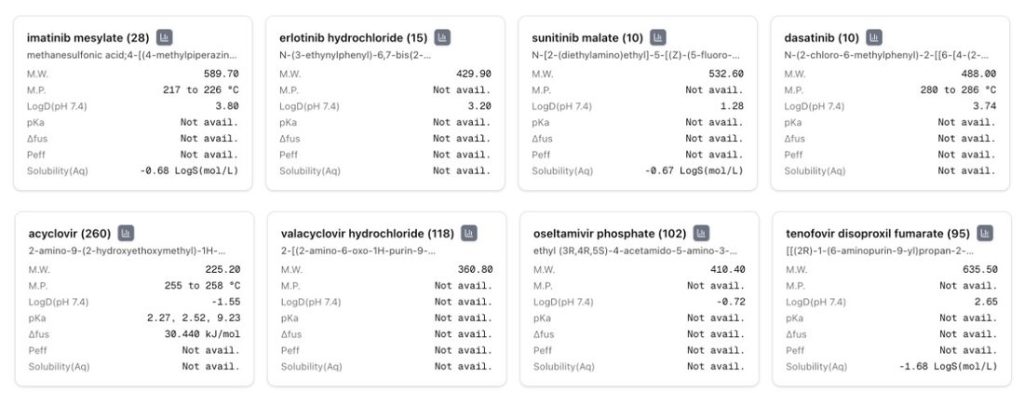
API surrogate search: Formulation starting points for a novel API
SitepKa output for one molecule in DMSO: A predicted pKa for each ionizable site. 2 of its 3 ionizable sites are shown.
Methods
Structure and property-based cheminformatics search · FDA formulation records · Data mining using Agentic AI
Challenge
A novel API has no formulation history, so the first excipients are often chosen by analogy and expertise.
Approach
The portal collates physicochemical data for ~3K approved APIs, such as melting point, pKa, logD and solubility, along with their inactive ingredients of ~150K FDA-approved formulations. Scientists can search by name, SMILES, structure or a property profile.
Evidence
Client engagement. The surrogate search model was deployed for a client’s formulation team in Europe.
Outcome: The approved drugs most similar to a novel API, and the excipients their formulations used, as starting points
See Igniva™ for Chemistry on your own problem
Bring the question you are working on, and we will show you which applications and agents apply.